Helmet Collage
Posted
3/17/02


The Northwestern Helmet:
A Retrospective Collage


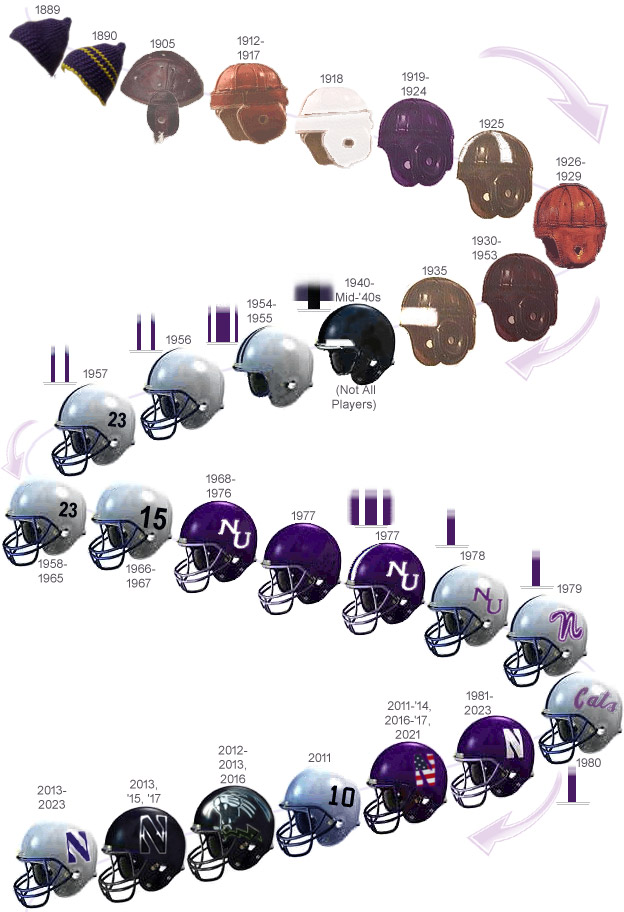
Northwestern has sported several different helmet designs over the years.  The last major change came in 1981, when NU introduced its purple helmet with the "Athletic N" design.  Here is a key to the collage above:


  1. NU, like all other teams, did not wear helmets until well into the twentieth century.  The inset example is a purple stocking cap worn by an NU player in 1889.
  2. By the late 1920s, many teams' helmets were branching out from plain brown leather.  Some schools even featured designs or distinctive stripes or markings.  NU chose plain, jet black leather with a cross design stitch.  In 1918 NU painted the helmet white, and in 1925 the helmet featured a white cross on the top.  Pictured is Reb Russell, from 1931.
  3. The cross stitch gave way to a smooth leather helmet, still all black.  The example is Vange Burnett, from 1936.
  4. For several seasons, the helmet had a white front piece.  Shown is Otto Graham in 1942.
  5. The photo is of Frank Aschenbrenner during the 1949 Rose Bowl.  Experiments with shell helmets and designs were brief, and NU had gone back to plain black leather, now with a "winged" stitch.
  6. NU switched to hard-shell helmets for good in 1954.  The first were white, with three purple stripes (in the "northwestern stripe" pattern: narrow, wide, narrow).  The tiny example included is from 1955.
  7. By 1956 The stripe design changed to two equal-sized stripes.  The design lasted for a couple of seasons.  Shown is Andrew Cvercko, from 1956.
  8. By the end of 1958 the stripes disappeared entirely, and the only design on the Wildcat white helmet were the players' numbers, printed in black on the sides, as seen on the edge of Chip Holcomb's helmet (from 1959.  Foreground photo).  In the background Paul Flatley catches a pass in a 1962 photo.  The black numbers were made larger on the helmets in 1966..  1967 was the last season for the plain white helmet.
  9. For the first time since brief experimentation in the early forties, NU had a purple helmet in 1968.  The helmet had no stripes and, for the first time, featured a logo-- an interconnected "NU" design in white.
  10. During John Pont's final season as head coach, in 1977, NU added two white stripes to its helmet.  It remained purple, with the white "NU" logo.
  11. Rick Venturi coached NU for three seasons, from 1978 through 1980.  During his three years, NU had three different helmets.  In 1978, NU went back to a white helmet, this time with a single purple stripe.  Venturi kept the "NU" logo (now in purple) on the sides.
  12. For the 1979 season, NU retained a white helmet with a purple stripe, but changed the eleven year- old "NU" logo.  It was replaced with a lower-case script "n" design that lasted just one season.
  13. 1980 brought yet another logo change: the "n" script was dropped in favor of a script design with the word "Cats."  The rest of the helmet design was retained.
  14. When Doug Single and Dennis Green took control of NU football in 1981, the team's logos, uniforms, and helmets were all redesigned.  The 'Cats went back to a purple helmet, this time with no stripes.  On each side was a new logo, an upper-case white stylized "N."  It was the sixth different helmet for NU in as many seasons.  However, it has proven to be a classic, since it has undergone only a few, very minor changes since its introduction over twenty-five years ago.  The example shown is from 1985, when NU briefly experimented with a slightly modified "N" with gray trim.
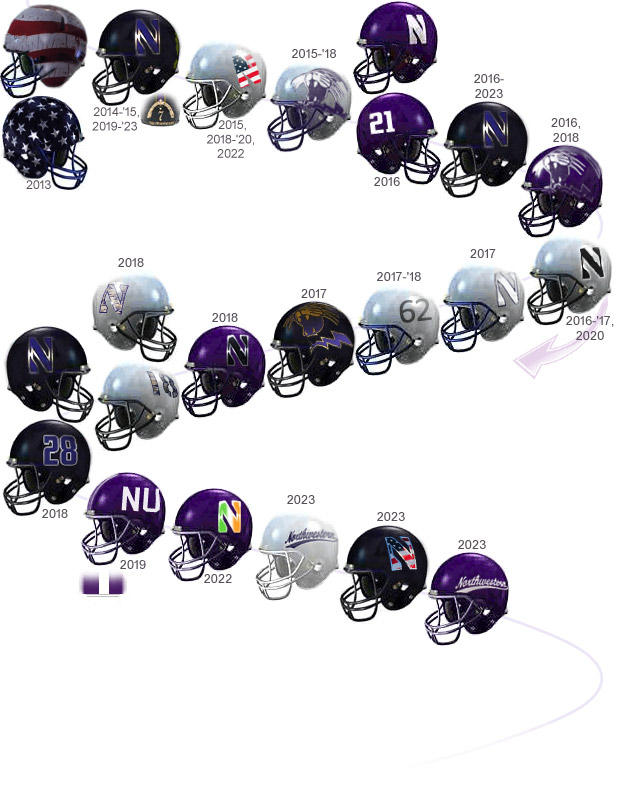
  15. The 1981 helmet, as it appears today.  The examples are from the 1995 Wheaties box and from 1997.  The face guard has changed from white, to purple, to black.  The purple paint is now more metallic than in the eighties.  And, since Barnett introduced them in 1994, players have been given award stickers to apply to the back of the helmet.  Randy Walker added a few new stickers, which now include a "cat head" for an outstanding game performance, a star for a great play, and a cat paw for outstanding special teams work.