|
|
|
The First Team
Posted
1/25/26
|
|
|
|
 |
|
|
Northwestern
kicked off the first complete game of American football in the Midwest
on Tuesday, February 22, 1876. As we near the 150th anniversary of this
(until recently) forgotten milestone, HailToPurple.com is posting a
series of articles about the game. This information uses research from
the 2023 book Gus Hornsby's Gamble, which describes that first game in detail.
Augustus
"Gus" Hornsby and William Curtis organized the first American football
team in the Midwest in the fall of 1875, when they created the Chicago
Foot-Ball Club. The CFBC was well-organized and well-funded, comprised
mostly of wealthy and famous Chicagoans. One thing the team lacked,
however, was an opponent. The team began playing American football by
splitting into squads and scrimmaging in early November, and tried to
muster an opposing team from other athletic clubs, including the
Chicago Barge Club. These efforts proved unsuccessful. The CFBC managed
to get some students from nearby St. Ignatius College to scrimmage with
them—the two teams played for about an hour, but Hornsby still
considered it a practice scrimmage. The search continued for a team to
play his new squad.
Several members of the CFBC had connections with students at
Northwestern, and they made a couple of attempts in November and
December to play the school in Chicago. Those efforts also went
nowhere. Finally, in early February 1876, some NU students agreed to
put together a team to face the CFBC later that month. This time, the
CFBC was finally able to stage its first full game, with a ragtag team
of NU students—and, eventually, a couple of Evanston townies for good
measure.
So, who was on Northwestern’s pioneering football team in 1876?
Unfortunately, no surviving list from that time exists. Neither the
school nor the CFBC kept any record of the NU players. Through careful
research, however, a partial list can be made. This information comes
from newspaper accounts, diaries, and other primary research records.
Here, then, is as complete a list as can be made.
|
|
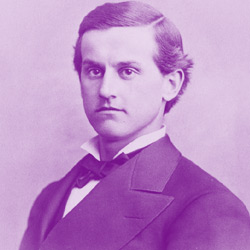
Frank
Casseday, Junior: Casseday was a key member of Northwestern’s strong baseball
team at the time. He was perhaps the most critical player for the new football
team. After hearing about the CFBC's invitation to a game from Theophilus
Hilton, it was Casseday who tried to organize the first team, beginning with
other members of the baseball team and expanding his search to some of the
students who had recently organized and built the school’s new gymnasium.
Cassedy, however, was small and not built for football, and he deferred to his
baseball teammate, Ed Kinman, to serve as the team's captain. Despite not being
the team’s captain, it was Casseday who was responsible for bringing NU’s first
football game to campus, and he was named the team’s president immediately
after the game.
|
|
|
|
|
|
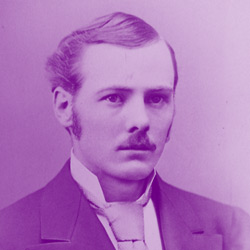
Ed
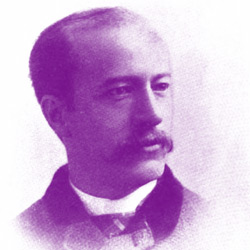
Kinman, Sophomore: As mentioned, Kinman was NU’s first football captain,
despite having no real experience with American football or its brother sport,
rugby. However, he was a talented athlete and a popular member of the baseball
team. He was from Jacksonville, Illinois, and a member of Beta Theta Pi. After
graduating, he eventually served in the Illinois state legislature.
|
|
|
|
|
|
Walter
Lee Brown, Senior: The first NU football team did not wear uniforms, but we do
know that Walter Brown decided to come decked out in blue, which must have been
confusing, since the CFBC wore matching blue football uniforms. After
graduating, Brown became a chemist and rare book collector.
|
|
|
|
No known image
|
|
Simon
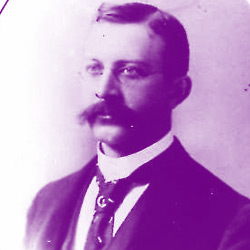
Douthart, Junior: He was just a junior, but Douthart was 30 years old, the
second oldest member of the NU team. A Civil War vet who came to college as an
adult, Douthart was a hulking giant raised on a farm. He stood nearly a foot taller
than most of his teammates and terrorized the CFBC players during the game. The
week before the game, Douthart had won a wrestling match against Walter Lee
Brown in the new gymnasium. Douthart died at age 88 in 1934, making him likely
the last surviving member of NU’s original football team.
|
|
|
|
|
|
Edwin
Munroe, Senior: While Brown wore blue in the first game, Munroe came to play in
a flaming red shirt—when he left the field, it was in tatters. Born in Florence,
Illinois, Munroe settled in Joliet, becoming a banker. He died in 1918, likely
as a result of the flu pandemic.
|
|
|
|
| No known image |
|
Edward
Esher, Freshman: Despite his age, Edward Esher proved to be one of the most
adept NU players on the initial team, impressing Hornsby with his skill. Esher
was the son of Bishop John Jacob Esher, who helped to found North Central
College in Naperville.
|
|
|
|
|
|
Fred
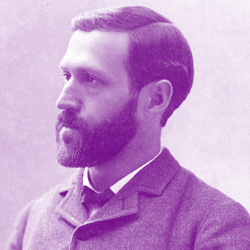
Manville Taylor, Senior: Tall, athletic, and well-mannered, Taylor did not make
many notable plays in NU’s first game, but he would go on to have a remarkable
career outside of athletics, eventually heading the University of Michigan’s department
of economics and becoming one of the nation’s foremost economists.
|
|
|
|
|
|
Frank
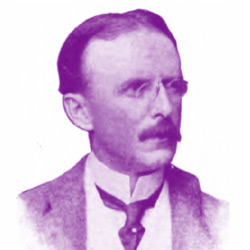
Scott, Senior: Scott played a competent enough game that Hornsby and Curtis
invited him to join the CFBC afterwards. There is no evidence that Scott accepted
the offer. He gained fame after school as a lawyer, eventually dying in 1931.
|
|
|
|
|
|
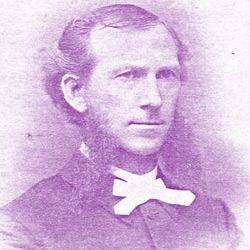
Theophilus
Hilton, Senior: It was Hilton who had received the first invitation from the
CFBC—Hilton’s cousin was a member of Hornsby’s club. A member of NU’s secret
society Spade and Serpent, Hilton recruited several of his fraternity brothers
to play, including Taylor and Scott. Hilton insisted on wearing his top hat
during the game; it was the right of seniors exclusively to wear silk top hats
on campus, and Hilton insisted on exercising that right.
|
|
|
|
| No known image |
|
Will
Arnold, Senior: A budding songwriter and—along with Douthart—one of two Civil
War vets on the team, he was thirty-three years old in 1876, older than many of
the CFBC players.
|


|
|
|