Northwestern
kicked off the first complete game of American football in the Midwest
on Tuesday, February 22, 1876. As we near the 150th anniversary of this
(until recently) forgotten milestone, HailToPurple.com is posting a
series of articles about the game. This information uses research from
the 2023 book Gus Hornsby's Gamble, which describes that first game in detail.
By Larry LaTourette
This
article posted on the date of the 150th anniversary of Northwestern's
first football game, played on February 22, 1876. Previous posts have
looked at the details of the game, the first NU team, the first playing
field, and the season and holiday that set the stage for this game. Now
we address the biggest question: so what? What made this game
significant—to Northwestern and to American football in the Midwest?
There are at least three aspects to consider.
1. IT WAS THE FIRST GAME STAGED IN THE MIDWEST
As previously described, the February 1876 game between the Chicago
Foot-Ball Club (the CFBC) and NU was the first full game of American football
played in the Midwest. While the CFBC had scrimmaged with other groups
in late 1875, including the Chicago Barge Club and St. Ignatius
College, the team considered these practice sessions. The week after
the NU game, CFBC co-founder Gus Hornsby referred to it as the CFBC's
"first 'foreign' match," rather than scrimmages the CFBC had played by
splitting its own teams into practice squads. In interviews conducted
in 1909 and 1922, Hornsby also refers to the Northwestern game as the
CFBC's first match. The game predates the match typically cited as the
first American football game in Chicago by over three years (the 1879
game between Michigan and Racine).
2. IT CLAIMED SEVERAL OTHER FIRSTS (OR EARLY DEVELOPMENTS)
Hornsby employed the Concessionary Rules agreed to by Harvard and Yale
in November 1875. This style of play, which favored Harvard's
rugby-style American football (as opposed to the prevailing
soccer-style football that most other Eastern teams played), was a
significant step forward in the development of American football. The
Northwestern-CFBC game was only the second-ever game anywhere that
employed American football's new rules.
Hornsby, however, modified two parts of the Concessionary Rules, and
these modifications are critical to the sport's development. First, as
an expert English rugby player, he insisted on using a rugby ball
instead of a round (soccer-style) ball. The Concessionary Rules favored
Harvard rugby but made a concession to Yale by allowing the use of a
round rubber ball. As a result, the Northwestern-CFBC game was the
first game anywhere to use the new rugby-style rules with an oval rugby
ball.
The second change Hornsby made was to the value of touchdowns. The
version of football favored by Yale, Princeton, Columbia, and most
other Eastern schools at the time didn't even count touchdowns: they
were only ways to give a team a better shot at a field goal. The
Concessionary Rules counted touchdowns, but weakened them so that three
touchdowns could be converted to one goal. Hornsby counted touchdowns
separately and scored them distinctly from goals.
Another first set by the February 1876 game: as mentioned in the
previous post, it was played on a holiday, making NU the first known
college team to play American football on any holiday. |
|

Program from the Concessionary Rules game, showing Yale's association ball
|
Regardless of which set of rules was used or where it was played, the
game makes Northwestern one of the oldest football teams among current
Division I schools. Only Princeton, Rutgers, Columbia, Yale, and
Harvard have older programs in Division I.
3. THE GAME HAD AN EFFECT ON CHICAGO FOOTBALL FOR YEARS TO COME
Strangely, the game had little lasting effect on Northwestern
athletics, but it did spark the events that would lead to
American football taking an early hold in Chicago.
In the wake of the 1876 game, Northwestern's players decided to form a
club and play by the new rules. However, they eventually decided to
play only intramural games, extending no invitations to other teams.
Within two years, the club disbanded, and students returned to playing
the earlier kicking game. The school turned down invitations to play
other teams in 1878, but did play a couple of high schools in
scrimmages in 1879 and 1881 (these games are rightly considered
unofficial). Eventually, Northwestern played Lake Forest in both
schools' first intercollegiate games in 1882.

Photo of William Curtis, taken shortly before he formed the Chicago Athletic Club
|
|
However, the
1876 match had a pronounced effect on the CFBC, and particularly on
CFBC co-founder William B. Curtis. Curtis and Hornsby had become
frustrated by early 1876 at their failure to orchestrate a full
football match, but the Northwestern game showed them that their
efforts could succeed. Curtis was not just the co-founder of the CFBC;
he was the co-founder of both the Chicago Athletic Club (in 1872) and
the New York Athletic Club (1868). Curtis was wealthy enough to split
his time between New York and Chicago, and he eagerly brought East
Coast athletic pursuits to Chicago, including—at Hornsby's
suggestion—American football.
After the success of the 1876 game, Curtis lined up other matches in
Chicago, even as Hornsby's involvement with his team began to drop off.
During the next three years, the CFBC played games against Beloit and
the University of Michigan's senior class. Crucially, Curtis also
staged matches against other teams he helped to set up in Chicago,
including the "Chicago Southsides" FBC. When the CFBC disbanded in
December 1879, Curtis turned his attention to these other Chicago teams
and recruited East Coast college football alumni living in the Chicago
area.
|
One of Curtis's early attempts at an alumni all-star team was the
Chicago Rugby All-Stars, which featured C.J. Williams (the CFBC's last
captain) as the All-Stars' captain. The team began playing in 1881. A
later effort produced the University Club of Chicago, which played
Michigan in 1884. By 1885, Chicago-area alumni and athletic association
teams proliferated, and the city's second independent team, the Chicago
Wanderers, was founded. Curtis folded the University Club alumni team
into his Chicago Athletic Club to form the highest-caliber team the
city had yet seen, and local interest in the sport exploded.
The University Club / Chicago Athletic Club dominated Chicago football
in the late 1880s through 1892. The team went undefeated and unscored
upon in 1889 (beating Northwestern 28-0). Curtis's creation drew in the
best talent from the East Coast, Michigan, and throughout Chicago. The
team's players transitioned to the Chicago Athletic Association in
1892. During the 1893 Chicago World's Fair, American football became a
featured attraction. Northwestern hosted the Denver Athletic
Association during the Fair, but the headlining game was the CAA taking
on Army, West Point's first road game aside from visiting Navy*.
|
|

|
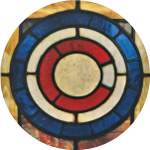
Stained glass depiction of the Chicago Athletic Club logo (a now-familiar Chicago symbol)
|
|
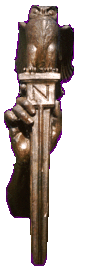
Sigil of the Chicago Athletic Association
|
By the mid-1890s, there were dozens of other athletic associations,
many of which formed solely to challenge the University Club / CAA
athletes. One such club, formed in 1898, was the Morgan Athletic Club
on Racine Street, which became known as the Racine Street Normals and
later the Racine Cardinals (the legendary origin of the club's
nickname: when team owner Chris O'Brien bought surplus jerseys from the
University of Chicago, the players complained about wearing Chicago's
maroon hand-me-downs. "That's not maroon," O'Brien is reported to have
said, "that's Cardinal red!"). The team became a founding member of the
NFL. Now located in Arizona, it is the oldest team in the league. The
Cardinals are the end result of the chain of interests set in motion
years earlier by William Curtis, who determined that football had a
place in Chicago.
*Army considers this game an exhibition, and does not include it in the team's official records.