|
|
 |
|
|
Pat Ryan Jr. Discusses
The Rationale Behind the New Ryan Field
Last
Thursday, Pat Ryan, Jr., spoke at Northwestern Library as part of the
Library's recent Leonard Lecture and Exhibit Series of events devoted to
the history and future of Wildcat football. Ryan, CEO of Ryan Sports
Development and leader of the Ryan Field rebuild project, discussed how
the new stadium came about and how its features will serve the
Northwestern and Evanston communities.
The new
Ryan Field is widely reported to be the most expensive new college
stadium in history, with an estimated cost of $850 to $875 million.
That is true; however, Ryan said the decision to rebuild the stadium
was partly based on the estimated cost the school would have faced if
it had decided to renovate the old facility again.
Several
years ago, Northwestern faced a problem: the old Ryan Field needed
significant upgrades and repairs. The stadium was last fully renovated
in 1997—a project so large that Pat Ryan Sr.'s contribution led to the
stadium's name change—nearly 30 years ago. By 2021, the infrastructure
of the 90-plus-year-old building was failing again. The stadium failed
to meet many new regulations, and much of it was built in the
pre-television era, when stadia were designed simply to pack in as many
people as possible.
NU
concluded that repairs and renovations would easily top $300 million,
and the stadium would still be fundamentally an artifact of the early
Twentieth Century: narrow concourses, limited concession capacity,
unfavorable sightlines, and a bowl designed to maximize capacity rather
than attendees' comfort and enjoyment.
|
|

Ryan, speaking October 8 at Deering Library
|
Ryan revealed that, if NU had chosen to renovate the old stadium again,
it still would have lost the two iconic western-side towers. The
towers' structure was so poor that they were likely beyond saving. So,
facing (at least) a $300 million renovation and the eventual loss of
the most famous components of the stadium, the school saw a
once-in-a-century opportunity: start from scratch, and design the new
stadium to be a twenty-first-century facility, providing attendees with
an experience they could not get from watching games on TV.
This opportunity let the school focus on "quality over quantity,"
designing seating with fantastic sightlines, providing expansive,
comfortable space for each attendee, and treating all areas in the
stadium as essentially premium.
Ryan explained that accessibility and other decisions were not just
about compliance, but also about fundamental empathy. For example, the
illustration on the left is of an early design for Ryan Field's
entrance:
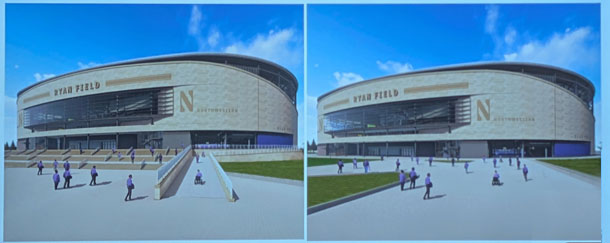
There would have been dramatic stairs leading into the
stadium, with an adjacent ramp for ADA compliance.
The architects, however, saw another opportunity. They had already
decided to sink the playing field more than 20 feet below street level
to lower the structure's overall silhouette (and make it less obtrusive
to nearby neighborhoods). This choice already put the main concourse at
street level, rather than one or two stories above it. By opening the
stadium entrance directly into that main concourse, fans could enter
Ryan Field without taking a single step up, eliminating the need for a
ramp. Anyone wishing to sit on a higher or lower level could take any
one of the fourteen new elevators once they entered the facility. As
Ryan put it, this was the empathetic solution, allowing fans with
disabilities to use the same entrances as everyone else.
This focus on empathetic choices extended to many details and helped
make the new stadium a special, welcoming home for Wildcats for
generations to come.



|
|
|