|
|
 |
|
|
A Stadium in Downtown Evanston?
What Might Have Been
As
Northwestern prepares this week for the "soft launch" of the New Ryan
Field, let's take a look at where the 50-yard-line seats almost ended
up:
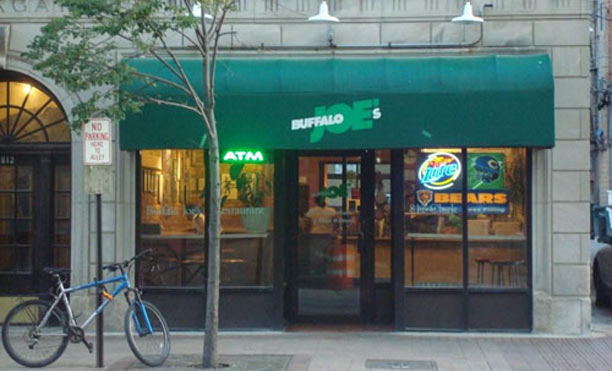
Wait: what?! How did this block end up as the iconic Buffalo Joe's in Evanston and not the sidelines for Wildcat football?
It goes back to a fateful decision over a hundred years ago, when
Northwestern was looking to expand its athletic facilities beyond its
main campus.
Since 1874, Northwestern's athletic grounds had been situated on its
main campus east of Sheridan Road.
But it wasn't always so: in its infancy, Northwestern used a field near
Davis Street in Evanston for its games, primarily early baseball. By
the fall of 1902, it was becoming clear that the school's on-campus
football stadium, Sheppard Field, was insufficient. Even though its
grandstands were only ten years old, the stadium could no longer
accommodate the football team's biggest games, and students angrily
protested against hosting games off campus in Chicago when the Purple
faced its most popular opponents.
So, in 1902 NU's business manager, Robert Sheppard (the namesake of the
on-campus stadium) began looking for a new site for an athletic field,
and his first idea was to move the grounds back south, near Davis
Street again.
Sheppard's suggestion was to locate a new stadium in the heart of Evanston, just a block north of Sherman Avenue and Davis:
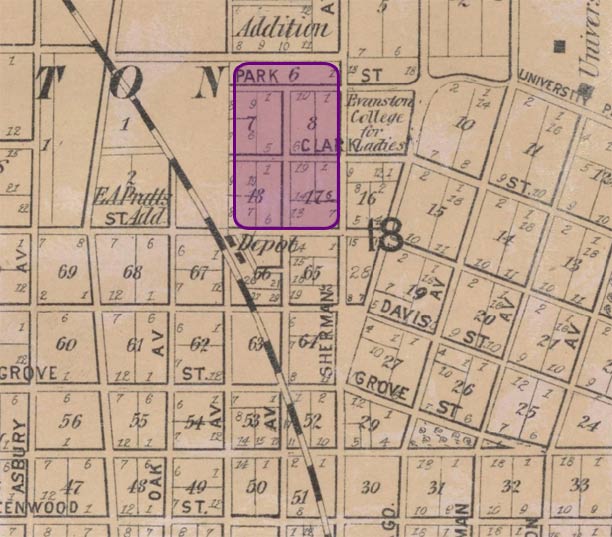
The
area, shown on a contemporary map, above, would have likely wiped out
part of Benson Avenue and Clark Street, closing both to through
traffic. The campus would have extended from Church Street north to
where University Place is now.
Sheppard saw two major advantages to this location. First, it was
closer to the main campus than other possible options (including spots
farther north on Central Street). Second, it was less than a block from
the Northwestern Train Depot (now the Davis Street Metra Station).
From our twenty-first century perspective, this location seems impractical, if
not impossible. However, we need to remember several things that would
prevent such a move now that were not problems in 1902. Currently,
there is a second train line running next to Benson Avenue (and leading
to the Davis El Station), but that train line wasn't yet built. Also,
Elgin Road would be affected now, but that street also wasn't yet
constructed in 1902.
As for the land, Northwestern owned or controlled all of the property
in question in 1902. In the late nineteenth century, NU owned roughly a
third of downtown Evanston. By 1902, that amount had been slashed to
five percent, but that five percent still included several important
lots.
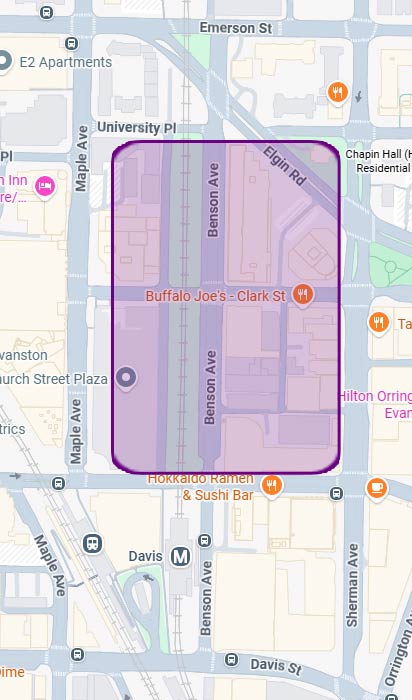
This modern map shows the proposed site for NU's football stadium. Note
the train tracks running down Benson Avenue; they did not exist in 1902.
While the idea of a Big Ten stadium in the middle of the Evanston
business district seems crazy now, it needs to be noted that if NU had
proceeded with this project, the Evanston downtown would have evolved
very differently from how it ended up. It's possible that the blocks
just west of Maple would have eventually been incorporated into this
campus as well.
The idea caught on with the school's administration, and in December
1902 NU announced that it planned to proceed with Sheppard's plans for
a Sherman Avenue stadium. However, the plans ended up delayed during
the holidays, and at some point in early 1903 an alternate site,
championed by William Dyche, replaced Sheppard's plan.
Dyche's idea, of course, was to take advantage of another train stop on
Central as the main conduit for game traffic and build an entire
athletic complex on NU-controlled land-- including a football stadium
and a baseball diamond, something Sheppard's location could not
provide. The Central Street facility was supposed to break ground in
the fall of 1903 and open in '04, but was pushed back a year. And the
property at Sherman and Clark slipped out of Northwestern's hands and
(eventually) into the spicy, spicy, wings of Buffalo Joe's.



|
|
|