|
|
 |
|
|
Northwestern Concludes Preseason
With Practice at Great Lakes
Return to NU - Great Lakes Ties
When
NU holds its final 2010 preseason practice tomorrow at Ross Field at
the Naval Station Great Lakes, it will signify a new era in the
relationship between the base and NU football, a relationship that had
close ties during the two world wars, but has been dormant since.
It is hoped that the 2010 scrimmage will begin a partnership, and that
the servicemen and women stationed at Great Lakes will root for NU, not
just as Chicago's team, but as Great Lakes's adopted team as well.
Great Lakes had itself once been a tremendous power in college
football. During the 1918 season, as military recruits poured in
from college campuses across the midwest, Great Lakes became the most
talented football team in the country. Among the new players for
Great Lakes was Paddy Driscoll, Northwestern's star player on the
fantastic 1916 Purple team. Driscoll played alongside future
Chicago Bears founder George Halas, and the pair helped to rip apart
the naval base's collegiate competition. Great Lakes opened the
1918 season by shutting out good Iowa and Illinois teams, before hosting
a showdown with Northwestern on October 26. Driscoll faced many
of his former teammates on a muddy field at the base, and the two teams
slugged their way to a 0-0 tie. It was the only time (until
2010) that Northwestern would travel to the base, and it was the
highlight of NU's season.
Great Lakes would also tie Notre Dame in 1918 before winning its next
three games. The Great Lakes regular season concluded with a
match against Purdue, which Great Lakes hosted at-- of all places--
Northwestern Field in Evanston! Great Lakes would go on to defeat
the Mare Island Marines on January 1 in the Rose Bowl, for perhaps the
base's greatest-ever football triumph.
In addition to Driscoll, the 1918 Great Lakes team had another NU
connection: its center, Charlie Bachman, would follow up his
performance as a player in the Rose Bowl by becoming, in 1919, head
coach for Northwestern.
Great Lakes fielded its next major football teams during World War II,
and played college schedules during the 1942 through 1945
seasons. Great Lakes played NU for three of those seasons, from
1942 through '44.
The Bluejackets caught NU in the midst of a drought of talent in 1942,
since most of the Wildcats' players had been siphoned off to other
campuses for the war effort. So it was no surprise when the
powerful Great Lakes team swamped NU at Dyche Stadium, 48 to 0.
However, Northwestern became the recipient
of several key military transfers before the 1943 season, and the
restocked 'Cats also benefited from star Otto Graham, who was in his
final year at NU. Graham and the 'Cats (see photo feature, below)
handed Great Lakes one of its two losses that year. Great Lakes
would end the season with a 10-2 record by whipping Notre Dame at
Soldier Field (the only loss for the Irish in 1943).
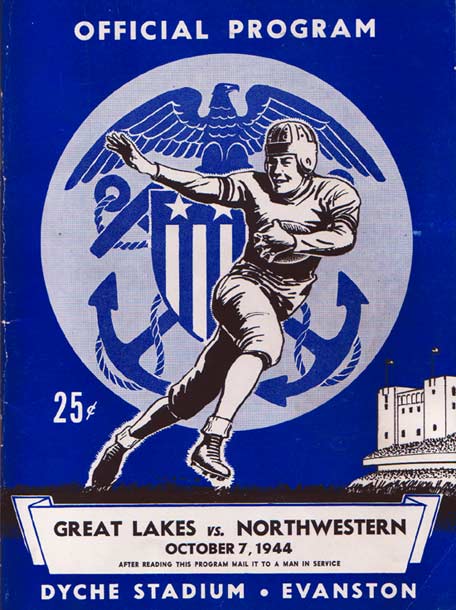
In Great Lakes's final meeting with the Wildcats, on October 7, 1944,
Great Lakes waxed the 'Cats 25-0. Again, the outcome was not too
surprising: Great Lakes was en route to a 9-2 record. Among the
1944 Bluejackets that NU faced was a former Wildcat. Richard
Eggers had recently transferred to Great Lakes for training. Also
on the '44 Great Lakes team was an unheralded back named Ara
Parseghian. Mr. Parseghian, of course, would have further
adventures at Dyche Stadium in another decade.
1945 would prove to be the final season that Great Lakes fielded a
football team to compete with major college teams. The
Bluejackets ended their major college football history by defeating
Notre Dame on December 1.
Below, from the NU Archives, are several photos of Wildcat great Otto
Graham, and others, in action versus Great Lakes at Dyche Stadium in
1943.
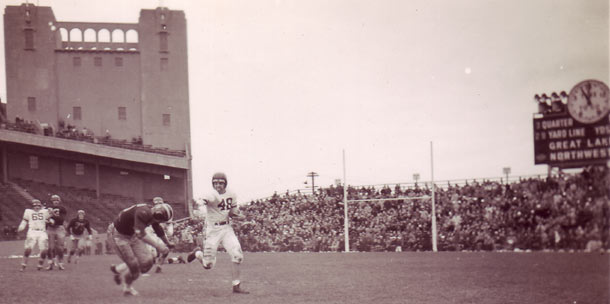 Graham pulls a stiff arm on his way to a first down.
Note the old north endzone scoreboard and stands.
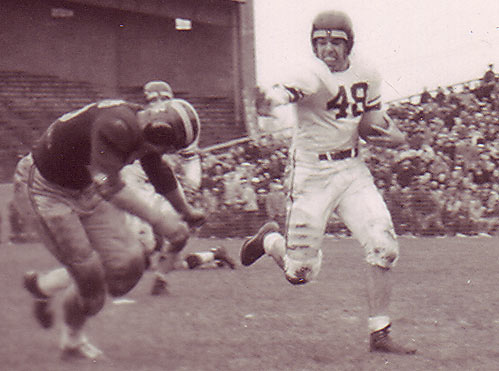
A close up of Graham's wicked stiff arm.
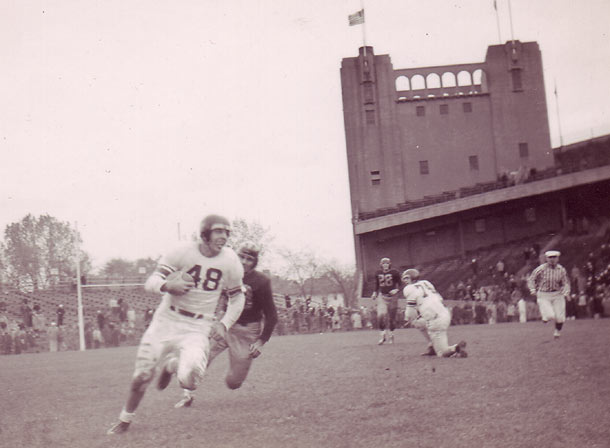
Graham on the run again.
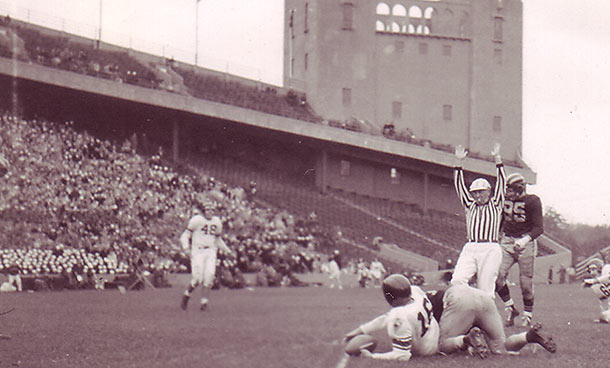
Next the air attack: Graham throws for the TD.

The 'Cats on defense.


|
|
|